
Why Two Similar-Looking Custom Chandeliers Can Have Very Different Prices
A custom chandelier does not have a reliable price per kilogram, per light or per meter. Two fixtures may look similar in a rendering but require different materials, tooling, finishing, engineering and assembly time. One may use standard glass components on a simple frame; another may need hand-formed brass, individually shaped glass and a ceiling plate engineered around the building structure.
For project buyers, the useful question is not only “How much does a custom chandelier cost?” It is “Which design decisions are driving the cost, and where can we simplify without losing the concept?”
You can review GUSURE Lighting’s custom chandelier collection to identify relevant forms and materials before requesting a project-specific quotation.
.jpg)
The Nine Main Cost Drivers
1. Overall Size and Decorative Volume
Diameter, height and overall drop influence the amount of metal, glass, crystal, cable and packaging required. Size also affects frame strength, module count, suspension design and labor.
A wide open-frame chandelier may use less decorative material than a smaller but very dense crystal design. For pricing, suppliers need complete dimensions rather than a general description such as “large lobby chandelier.”
2. Material Selection
Material is one of the most visible price variables.
- Iron or steelcan be efficient for structural frames and painted finishes.
- Stainless steeloffers a clean modern appearance and can suit polished or brushed details.
- Brass and coppercreate a warmer premium effect but involve different raw-material and fabrication costs.
- Glassranges from repeatable molded pieces to hand-blown or textured decorative components.
- Crystalprice varies by grade, cut, size and quantity.
- Alabaster or alabaster-style materialsrequire careful selection, cutting and support.
- Acryliccan reduce weight and enable large modular shapes, but custom fabrication still affects cost.
Mixed-material designs should specify which components use each material. “Brass chandelier” might describe a solid-brass decorative structure, brass plating over another metal or simply a brass-tone painted finish. These are not equivalent.
3. Surface Finish
Standard powder coating is normally more straightforward than complex electroplating, hand-applied patina, multi-layer finishing or exact finish matching.
Cost may increase when a project requires:
- Brushed or polished surfaces
- Antique brass or bronze effects
- Champagne gold or custom plating
- Hand-applied aging
- Multi-color finishes
- Exact matching to an approved control sample
- Outdoor or high-humidity finish systems
Ask for a physical finish sample when color and texture are critical. Screen images cannot reliably show metallic sheen.
4. Decorative Component Complexity
Repeated standard components are usually more economical than hundreds of unique pieces. Hand-blown glass, individually cut stone, shaped ceramic leaves or custom crystal arrangements add tooling, sampling and quality-control time.
Complexity also affects assembly. A chandelier with 500 identical drops can use a clear installation map. A sculptural fixture with many different lengths, angles and components requires more labeling and checking.
5. Frame Engineering and Suspension
The decorative concept must be supported by a safe, manufacturable structure. Large fixtures may require a reinforced central frame, multiple suspension points, secondary safety provisions, adjustable cable systems or modular connections.
Engineering effort rises when:
- The chandelier spans a large ceiling area
- Weight is distributed across several suspension points
- The ceiling is sloped, curved or irregular
- The fixture must follow a staircase or atrium
- Components need onsite alignment
- Access for installation is limited
- The design must be divided for transport
Structural design is not the place to make blind cost cuts. It should be coordinated with the project’s responsible architect, engineer and installer.
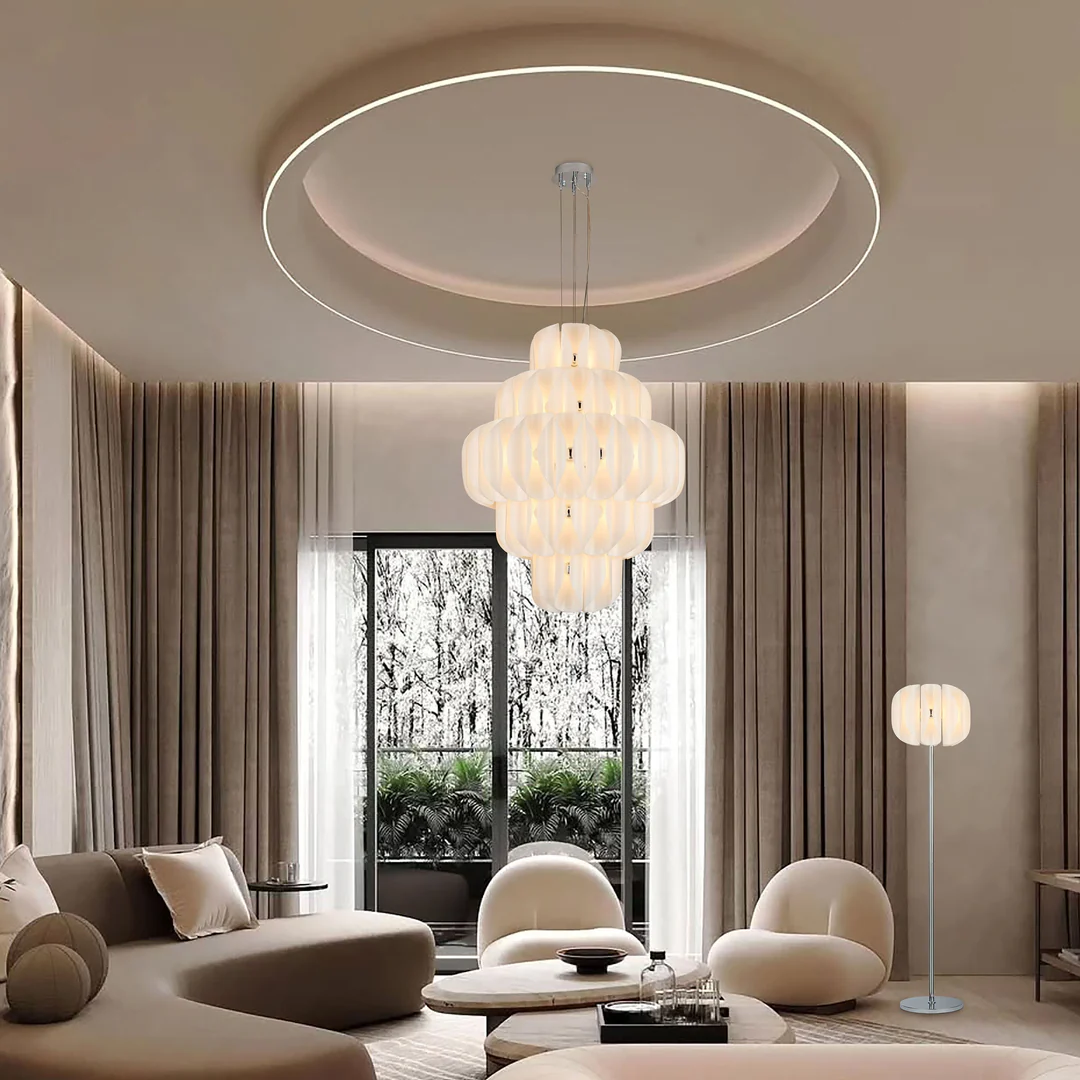
6. Light Source, Driver and Control
Decorative fixtures can use replaceable lamps, integrated LED modules, LED strips, fiber optics or combinations of these. Dimming and control requirements influence driver selection and wiring.
The quotation should state:
- Light-source type and quantity
- Color temperature
- Color-rendering requirement
- Driver brand or performance level if specified
- Dimming protocol
- Input voltage
- Driver access
- Emergency or special-control requirements, if applicable
A non-dimmable residential configuration and a large hotel chandelier integrated into a project control system should not be priced as the same product.
7. Quantity and Repetition
One-off statement pieces carry development, drawing, sampling and setup costs across a single unit. A repeated series can distribute those costs across more fixtures.
Quantity does not always create a simple percentage discount. If every chandelier has a different size or glass arrangement, production remains highly customized. The best economies come from controlled repetition: shared frames, common finishes, repeated glass components and consistent electrical specifications.
8. Packaging and International Delivery
Large chandeliers often need more than a standard carton. Costs may include:
- Custom foam or protective inserts
- Reinforced export cartons
- Plywood or wooden crates
- Separate packs for frames and decorative pieces
- Numbered component boxes
- Spare glass or crystals
- Moisture protection
- Packing lists and installation labels
Packaging should be designed with the installation sequence in mind. The cheapest crate is not economical if components arrive mixed, damaged or difficult to identify onsite.
9. Documentation, Testing and Project Support
Detailed shop drawings, finish samples, prototypes, installation diagrams, component schedules and inspection records require time. They can also prevent expensive misunderstandings.
Projects should define documentation requirements before quotation. If approval drawings, mock-ups or third-party testing are introduced after the order, cost and lead time may change.
Why a Price Range Without a Specification Can Be Misleading
A supplier can offer a rough budget based on a reference image, target size and material direction, but a final quotation requires decisions. If key information is missing, the price may be built around assumptions that differ from the buyer’s expectations.
For example, “three-meter glass chandelier” does not confirm:
- Type and quantity of glass
- Frame material
- Finish
- Fixture height
- Light-source arrangement
- Suspension method
- Dimming
- Installation conditions
- Packing standard
The more clearly these items are defined, the more useful the quotation becomes.
How to Reduce Custom Chandelier Cost Without Making It Look Cheap
Value engineering should protect the design intent while simplifying hidden complexity.
Standardize Invisible Components
Use proven connectors, suspension parts and drivers where they do not alter the appearance.
Repeat Decorative Modules
A sculpture can feel organic even when it uses a controlled family of repeated glass or metal elements.
Simplify the Internal Frame
Keep the visible silhouette while reducing unnecessary curves, welds or unique joints inside the structure.
Choose the Right Finish Method
If a plated finish is not essential, a well-controlled painted or powder-coated finish may achieve the desired tone at lower cost.
Design for Assembly
Fewer connection types, clear numbering and accessible fixing points reduce factory and onsite labor.
Confirm the Budget Early
Sharing a realistic target budget allows the manufacturer to propose appropriate materials and construction before detailed development.
Comparing Quotations from Different Chandelier Suppliers
Do not compare only the final total. Check whether each quotation includes the same scope.
Review:
- Dimensions and quantity
- Material thickness and material description
- Finish method
- Decorative component specification
- Light sources and drivers
- Dimming or controls
- Canopy and suspension hardware
- Drawings and samples
- Packaging type
- Spare parts
- Shipping term
- Installation support
- Lead time
- Exclusions
A lower price may simply exclude crates, drivers, installation diagrams or finish samples.
Information to Send for a More Accurate Quote
Prepare:
- Project type and location
- Application area
- Reference image or rendering
- Target dimensions
- Ceiling height
- Quantity
- Preferred materials and finish
- Light source, CCT and dimming
- Input voltage
- Ceiling and suspension information
- Required documents or samples
- Destination
- Target installation date
- Budget range, if available
GUSURE Lighting supports custom development from visual references, sketches and drawings. An early concept budget can be refined after the structure, materials and electrical specification are confirmed.
A Practical Quotation Process
- Send the concept, dimensions, quantity and project schedule.
- Confirm the material and finish direction.
- Review the proposed structure and installation concept.
- Clarify the electrical and control specification.
- Agree on sample, drawing and packaging requirements.
- Receive a detailed quotation with inclusions and assumptions.
- Approve drawings and finish references before production.
Price Should Be Evaluated Against Project Risk
The true cost of a custom chandelier includes more than factory price. A fixture that is difficult to install, inadequately packed or impossible to maintain can create additional site labor and delay.
Good value means the chandelier achieves the intended design, arrives in installable condition and has clear documentation. For international hotel, commercial and luxury residential projects, predictable execution is often more valuable than the lowest initial price.
.png)
FAQ
Can a custom chandelier be quoted from a reference photo?
A preliminary budget may be possible, but final pricing requires dimensions, materials, finish, light source, quantity, suspension and packing details.
Why is a one-off chandelier more expensive per unit?
Design development, drawings, sampling, setup and engineering are allocated to one piece rather than repeated across a production quantity.
Does a larger chandelier always cost more?
Not necessarily. A large open-frame design can cost less than a smaller chandelier with dense hand-made glass or complex crystal detailing.
What is the best way to lower chandelier cost?
Use repeated modules, standardize hidden components, simplify the internal frame, select an appropriate finish process and confirm the target budget early.
Should shipping crates be included in the quotation?
Yes. Confirm the exact packaging type, spare parts and whether packing is designed for the planned installation sequence.